Contents
Pick a graduate-level concept from psychology. Write an indirect fable that fully conveys the concept, keeping it subtle enough that the reader only realizes what it is near the end.
After the story, add an explanation clearly walking through the concept you were exploring.
This prompt comes from philosopher Amanda Askell at Anthropic. It is a wonderfully crafted framing that turns LLMs like GPT into endless machines for storytelling.
Here is the story generated from this prompt, which I loved deeply:
The Clockmaker and the City of Untimely Chimes
Long ago, there was a city called Echo Town.
In Echo Town, people lived by their clocks.
Not ordinary clocks.
When anyone was born, they were given a small handheld clock. It had no numbers on its face—only a single needle. Wherever the needle pointed, the person followed.
When it pointed east, they sought out friends.
When it pointed west, they stepped away from crowds.
When it pointed up, they went after an opportunity.
When it pointed down, they stayed right where they were.
The townspeople believed this clock could tell them what to do right now.
Sometimes, the clock would give a quiet chime.
Chime.
That meant: something is not right.
If someone was about to speak up and the clock chimed, they closed their mouth.
If someone wanted to reach out to someone new and it chimed, they took a step back.
If someone was preparing to leave an unhealthy relationship and it chimed, they thought: maybe I should wait.
The people of Echo Town never found this strange. Everyone lived this way.
At the center of town stood a tall clock tower.
It was tended by an old clockmaker who, people said, could understand what clocks were saying.
One day, a young man came to see him.
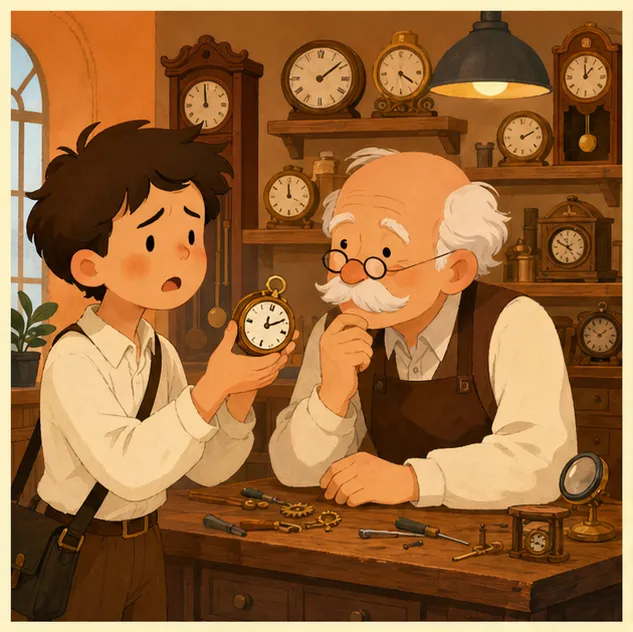
“My clock is broken,” the young man said.
“How so?” asked the clockmaker.
The young man set his clock on the workbench.
“It chimes randomly.”
“When does it chime?”
“Whenever I’m about to do something that matters.”
“For instance?”
“When I want to apply to the northern academy, it chimes.”
“When I want to tell a friend that they hurt my feelings, it chimes.”
“When I want to take my paintings to the open market, it chimes.”
“When I want to invite someone on a walk, it chimes.”
The clockmaker picked up the clock and held it to his ear.
The clock was completely silent.
The young man grew anxious: “You see? It’s quiet now. But the moment I’m about to take real action, it chimes. It’s warning me.”
“What do you think it’s warning you about?”
“Failure. Humiliation. Rejection. Being disliked. Choosing the wrong path.”
The clockmaker nodded gently.
“And do you obey it?”
The young man hesitated.
“Of course I do. It always knows more than I do.”
The clockmaker did not open his toolbox right away.
Instead, he led the young man to a back room behind the tower.
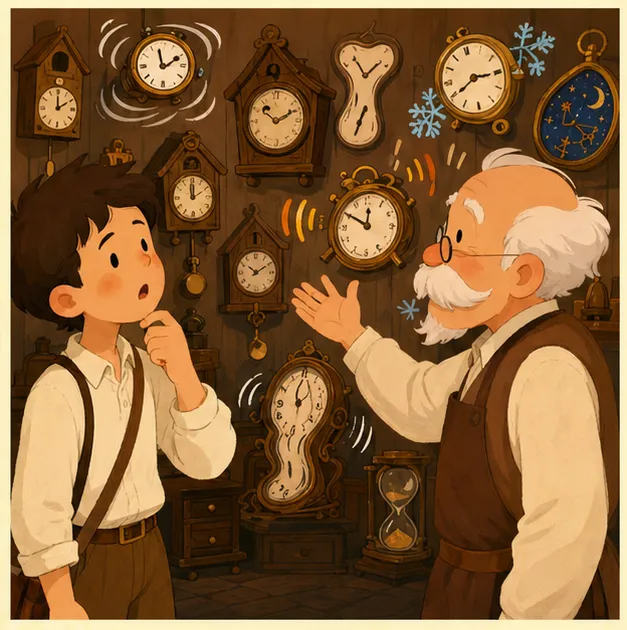
The room was filled with old clocks covering all four walls.
Some had needles spinning wildly.
Some were forever frozen at dusk.
Some let out a sharp chime every few seconds.
“Are all of these broken?” the young man asked.
“People once thought so,” said the clockmaker.
He pointed to the first clock.
“Its owner grew up in a wooden cabin that frequently caught fire. The clock chimed whenever it smelled smoke. Later, the owner moved into a stone house where the hearth was only used for warmth. But whenever smoke drifted by, the clock still chimed.”
He pointed to the second.
“Its owner misread a letter in front of a crowd as a child and was laughed at for years. She grew up to be a gifted scribe, yet whenever anyone watched her write, her clock jumped frantically.”
He pointed to the third.
“Its owner once loved someone deeply, but that person ran hot and cold. Later, he met someone kind and steady. Yet whenever she drew close, his clock urged him to run away.”
The young man listened, his brow furrowing.
“So these clocks just have too good of a memory?”
“You could say that,” said the clockmaker.
“Then why not erase the memory?”
The clockmaker smiled.
“Because clocks aren’t made to record the past.”
“Then what are they for?”
“To guess what will happen in the very next moment.”
The young man paused, puzzled.
The clockmaker pulled a fresh clock from a drawer. Its casing was clear glass, revealing an intricate gearwork inside.
“You think the clock is listening to the world outside. But first, it constructs an entire world within itself.”
“Based on old experience, it makes an advance guess: what does this moment mean?”
“If it guesses danger, it chimes.”
“If it guesses safety, it stays quiet.”
“What if it guesses wrong?”
“Then it needs new evidence.”
The young man looked down at his own clock.
“So should I ignore it?”
“No.”
The clockmaker handed the clock back to him.
“When it chimes, do not obey it immediately, and do not fight it immediately. First, ask it: What do you think is happening right now?”
The young man found this puzzling.
Yet he tried it.
The next day, he took his paintings to the marketplace.

Right as he reached the gate, the clock chimed.
Chime.
He froze.
In the past, he would have turned around and walked home.
This time, he looked down and asked: What do you think is happening right now?
The clock did not answer in words.
Instead, a memory flashed into his mind:
Years ago, he had shown a painting to his father. His father glanced at it and said, “Stop wasting your time on useless things.”
Standing at the market entrance, his palms sweated.
He realized: You think I’m still standing in that room.
So he did not force himself to sell anything right away.
He took one tiny step.
He walked into the market and simply stood there for ten minutes.
The clock chimed urgently.
Yet ten minutes passed, and no one mocked him.
On the third day, he went back.
This time, he laid his paintings out.
The clock chimed.
Passersby glanced at them. Some walked past quietly.
Someone asked about the price, then moved along.
Another person said, “I really like these colors.”
When he walked home that evening, the clock was not silent, but the chime was softer than before.
A week later, he sold his first painting.
The clock did not celebrate.
It simply paused for a brief beat—as if encountering something that didn’t fit its old rules.
Later, the young man did many similar things.
He wrote a letter to the northern academy.
The clock chimed.
He didn’t tear it up. He just finished writing it and let it sit.
The next day, he reread it.
The third day, he asked a friend to look over it.
On the fourth day, he mailed it.
He told his friend: “When you said that the other day, it actually hurt.”
The clock chimed.
He didn’t swallow his words.
His friend fell quiet for a moment, then said: “I’m sorry. I didn’t realize.”
His clock paused again.
Not because the world had suddenly become entirely safe.
Because it had received new evidence.
Years later, the young man became an accomplished painter.
His clock still chimed.
Before an important exhibition, when drawing close to someone dear, when speaking an uncomfortable truth.
Yet he no longer treated the chime as an order.
He treated it as a letter from his past self.
The letter usually said:
“I’ve seen danger before.”
“I was hurt before.”
“This is how I learned to protect you.”
The young man would read it carefully.
Then he would look up at the world before him.
Sometimes he took a step back.
Sometimes he took a step forward.
Sometimes he whispered: “Thank you for the warning, but that’s not where we are today.”
Many years later, the painter became the new clockmaker.
One day, a young woman walked into the tower.
“My clock is broken,” she said. “It always chimes whenever I want to be seen.”
The clockmaker held the clock to his ear.
It was quiet.
He did not tell her it was broken.
He simply asked:
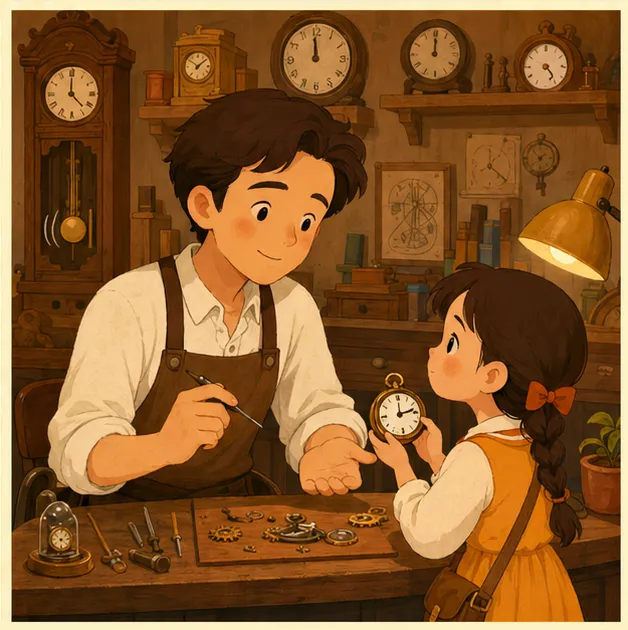
“Did it learn a guess about the world long ago?”
The young woman looked up, surprised.
The clockmaker smiled gently:
“Let’s not rush to fix it.”
“First, let’s see where it thinks you are still standing.”
The Concept Behind the Fable
This story is an exploration of Predictive Processing (or Predictive Coding) in cognitive science and psychology.
Its central thesis:
The brain does not passively take in reality; it continuously predicts reality based on past experience.
We often assume perception works like this:
See the world → Feel an emotion → React.Predictive processing shows the reverse:
The brain generates predictions from past models → Sensory input updates prediction errors → Feelings and actions emerge from this predictive loop.In the story:
- The clock = The brain’s predictive engine
- The chime = Bodily and emotional signals (anxiety, tension, shame, avoidance impulses)
- Past experiences = The source data training the internal model
- “Where it thinks you are” = The brain interpreting the current situation through an old threat template
- New evidence = Gathering corrective experience through tiny, safe actions
- Neither obeying nor fighting the clock = Treating emotions not as objective facts, but as predictive signals
Take social anxiety: someone feels intense tension before speaking.
On the surface:
I have to speak, so I feel afraid.
Beneath the surface:
My brain predicts: people will mock, reject, or attack me.
The nervous system enters defense mode in advance.
I feel as if danger is already here.
That sense of danger does not mean danger is present.
It simply means: your brain is interpreting the present through a past model.
This is why telling yourself “don’t be anxious” or “there’s nothing to fear” rarely helps. The predictive model operates at an embodied, autonomic level.
What actually works:
- Identify what the emotion is predicting.
- Avoid mistaking the prediction for reality.
- Take small, manageable actions to gather new, safe experiences.
- Allow your brain to update its internal model incrementally.
That is why the pivotal question in the story is:
Where does it think you are still standing?
It asks:
Which past situation is your brain mapping onto this current moment?
Many emotional burdens are not failures of character; they are your nervous system’s outdated attempts to keep you safe.
The secret is showing it that today is a different room.